Your terminal at a glance
TOS Software: Modules & Features
Start modular, extend as needed: smartTOS covers all core processes of your terminal, from gate to billing.
Modules in detail
Functions by area: gate, rail, yard and billing
Pick an area: the functions belonging to it appear below.
From the pre-gate parking area to the exit: smartTOS guides every truck visit digitally through the terminal, with short waiting times at the gate and even without staff.
Truck gate management
Control all truck visits centrally: from registration through release to exit. Reference number or PIN are checked at the gate, and on collection the lifting order is created automatically with the release. Optionally a videogate reads plate and container number by OCR.
Driver self check-in
Drivers register themselves, at the on-site touchscreen kiosk or by QR code on their own smartphone, with no app and no sign-up. The entry monitor at the buffer area shows who may drive in. That shortens waiting times at peak, even without staff.
OCR integration & video gate
A video gate reads licence plates, UIC wagon numbers and container numbers automatically and reports them to smartTOS. The system records every OCR event, assigns it to the truck visit or the train and answers with a control decision. Nothing is typed in twice.
Gate inspection & damage documentation
Condition and data of every delivered unit are captured directly at the truck, on a mobile device and with photo documentation. The images are stored audit-proof with the loading unit's record: an unbroken chain of evidence instead of arguments with customers and forwarders.
Trains set the rhythm of the terminal. smartTOS controls them across the entire lifecycle: from pre-notification through unloading and loading to shunting.
Train dispatching
Control trains across the entire terminal lifecycle: you dispatch with complete data instead of shouted updates and gut feeling. Wagon lists arrive by interface or Excel rather than being retyped; unloading control, load planning and shunting run in the same view, including warnings on length and weight deviations.
Mobile wagon check
Train inspection directly at the track, via an offline-capable tablet app that also works with poor network coverage. Unloading starts as soon as the first wagon is checked. The system creates the lifting orders for it once the train is processed.
With smartTOS, trimodal terminals also integrate inland waterway barges, in the same system as rail and road.
Lifting orders are generated automatically from operational events, while yard management keeps the stock geo-referenced and up to date in real time.
Crane & lifting orders
Lifting orders are generated automatically from operational events (train arrival, truck release, load planning) and arrive prioritised on the tablet in the crane. The crane operator sorts the queue by FIFO, distance or train cut-off; optionally a crane positioning system takes over order selection and completion.
Reach stackers & forklifts
The same order control as in the crane, directly on the tablet mounted in the vehicle. Orders and transport lists are held locally so that fluctuating network coverage does not slow operations; device parameters and working areas make sure each vehicle only receives orders it can handle.
Yard management
Every loading unit geo-referenced, every container findable: a visual yard overview with stack view, filters and free slots at a glance. Rule-based storage areas check stacking height, container type and load status on put-away, and hybrid slots make better use of the surface.
The empty container depot and repair management cover the complete depot process, from empty return to the invoiced repair.
Empty container depot
Manage the shipping lines' returns and releases digitally: depot orders are imported and matched automatically to the right container on delivery and collection. Movement messages and daily stock reports go to the line in COPARN, CODECO and COEDOR without anyone lifting a finger.
Container repair
From documented damage to the invoiced repair: damage is recorded on a mobile device in ISO 9897 format, the standard shipping lines accept. The container stays blocked until completion, and estimate and actual costs draw on the service catalogue and go straight into the invoice.
Dashboard, billing and reporting turn operational data into management insight, for dispatchers, back office and executives.
Terminal dashboard
The entire terminal at a glance: yard, track occupancy and loading areas live in the real layout. You trigger repositioning by drag & drop, and the system creates the lifting orders. The search finds individual units or everything flagged as dangerous goods right in the terminal view.
Billing & service catalogue
Billing straight from operations, not afterwards: lifts, storage costs, container inspections and repairs are generated automatically from each loading unit's transaction data. Prices, validity periods and tiered storage rates live in the central service catalogue, and the export goes to your billing system.
Reporting & analytics
Reliable KPIs from operations: Where do waiting times occur? Which relations are growing? What does the terminal actually earn money with? Four standard reports cover loading units, lifting orders, wagon history and message log, with free column selection, Excel export and saveable templates.
smartTOS speaks your partners' language: forwarders pre-notify themselves, operators and shipping lines are connected via EDI standards.
Forwarder self-service
Forwarders pre-notify deliveries and collections themselves and manage their trucks and drivers through a web interface, without phone calls and email lists. The terminal plans truck arrivals instead of discovering them at the gate; on collections the forwarder only sees units that are actually available.
Interfaces & partner systems
Bookings, train data and status messages flow automatically via established EDI standards. Orders arrive as EDIGES and are matched to transport orders, arrivals and departures go back as CODECO, stock reports as COEDOR and depot orders as COPARN.
Architecture & operations
EU cloud or on-premise, operated around the clock
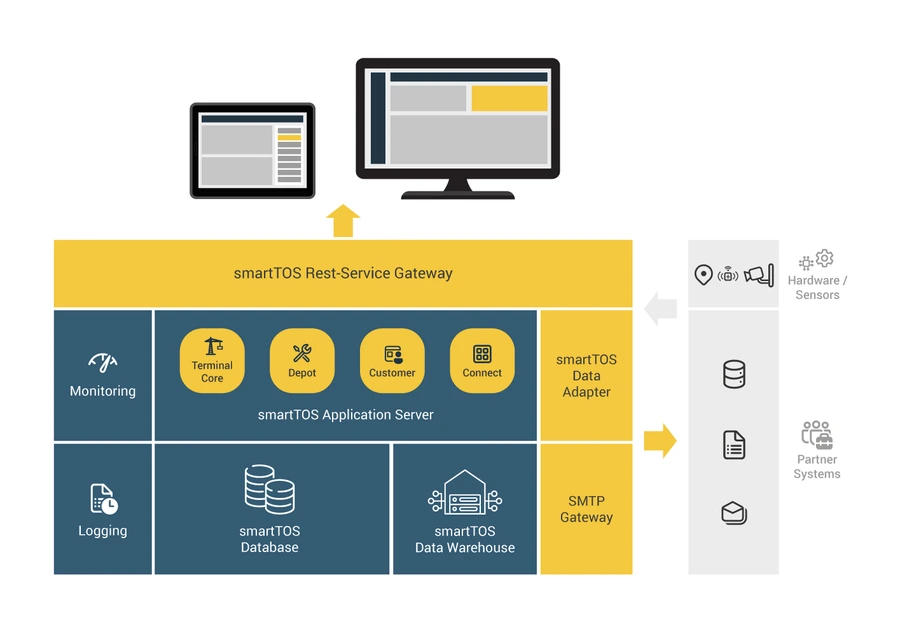
smartTOS is an offline-capable web application for desktop and mobile devices. It runs either as a scalable SaaS solution in the EU cloud or on-premise in your infrastructure.
Evolit operates the system with active security screening, function monitoring (health checks) and 24/7 support, under ISO 9001 and ISO 27001 certified processes.
- SaaS in the EU cloud or on-premise operation
- Offline-capable web application for desktop and mobile devices
- 24/7 monitoring and support
- Continuous product development
Why smartTOS
Best practice from 25 years of terminal operations
25+ years of terminal experience
Built by a team that has kept terminal systems running in live operation for more than 25 years. Operation, development and support come from a single source: data held in the EU, active security screening and round-the-clock monitoring, under ISO 9001 and ISO 27001 certified processes.
Intuitive application design
Screens that dispatchers, gate staff and crane operators use without a manual. That keeps the training effort low across every shift; the rollout ends with train-the-trainer.
Modular and delivered as SaaS
The scope runs from the gate to billing, and you license what your terminal uses. Extensions happen while running, without a second project. Scalable operation in the EU cloud or on-premise, maintenance and updates included.
FAQ
Frequently asked questions about smartTOS
Which areas of the terminal does smartTOS cover?
How modular is smartTOS?
How complicated is setting up smartTOS?
Does smartTOS run in the cloud or on-premise?
Does smartTOS work on mobile devices?
Can crane, gate and OCR systems be connected?
How does partner data get into smartTOS?
Who continues to develop and operate smartTOS?
Which modules does your terminal need?
In a demo we show you how smartTOS maps your actual processes, from gate to billing.
Request a demo